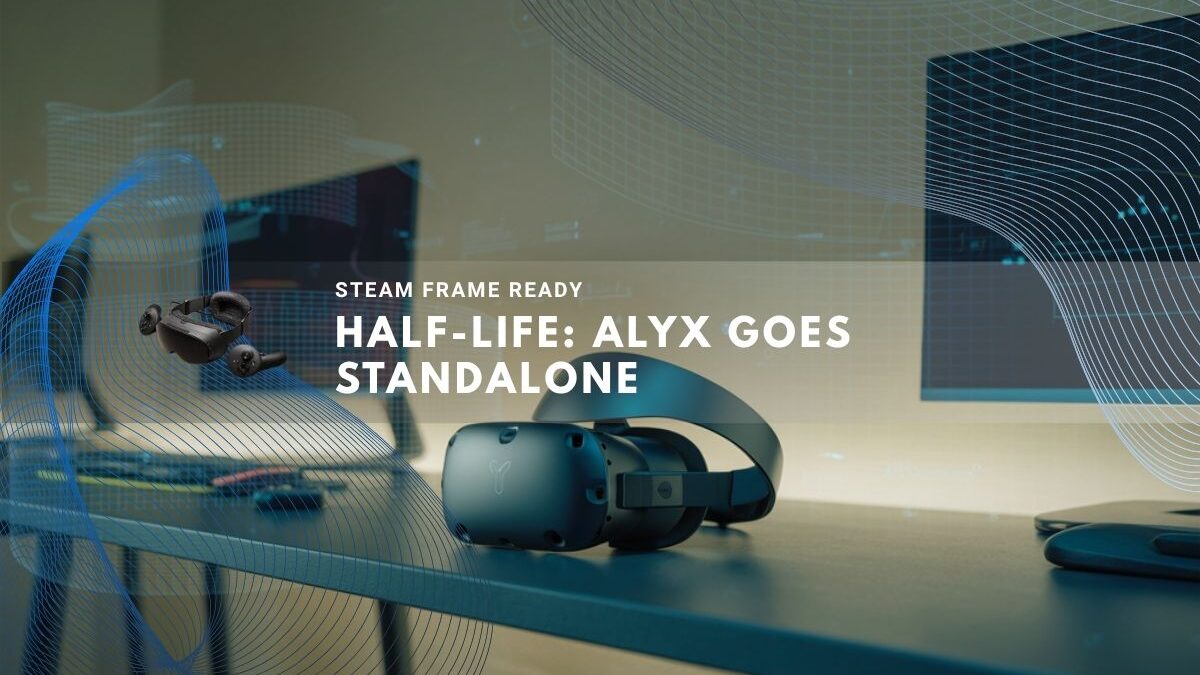
Valve is working to make Half-Life: Alyx run smoothly on its new Steam Frame VR headset without needing a PC. This could change how players experience the game.
Valve's Steam Frame VR headset
Focus on standalone gaming
Impressive PC streaming
Foveated streaming technology
Optimism for local game performance
Potential for standalone Half-Life: Alyx
Players await developments
Half-Life: Alyx currently runs excellently when streamed wirelessly from a PC to Valve’s Steam Frame headset. Valve’s foveated streaming technology delivers smooth gameplay with negligible latency, offering a responsive VR experience without requiring the headset’s internal processing power. These strong results show how well Alyx streaming performs on the device and set a clear contrast with Valve’s long-term goal of enabling Alyx standalone capabilities. Valve is also exploring future Alyx standalone play options as part of its broader efforts to expand the Steam Frame’s functionality.[1][8][9]
Standalone Play Ambitions
Valve is actively investigating making Half-Life: Alyx a solid standalone experience on the Steam Frame. The headset runs on an ARM-based Snapdragon 8 Gen 3 chip with 16GB RAM and SteamOS for ARM, enabling local game execution.[2][7][1]
Valve confirms standalone performance is a key goal but has not promised a release timetable or guaranteed outcome.
Running Half-Life: Alyx natively involves overcoming substantial technical hurdles, including translating x86-based game code to ARM architecture with minimal performance loss by using a compatibility layer (similar to Apple’s Rosetta but tailored for VR games).[1][2]
The Steam Frame’s GPU performance is similar to the Steam Deck, suitable for medium settings of the game, but challenges remain due to CPU limitations and battery life constraints (approximately 1 hour of battery life for native gaming compared to around 3 hours for streaming).[1]
Technical Challenges
Half-Life: Alyx requires a Core i5 7500 or Ryzen 5 1600 CPU minimum, with a GTX 1060 or RX 580 GPU.
Steam Frame’s ARM CPU must run the game’s x86 instructions via a translation layer, increasing CPU load and complicating stable VR frame rates.
Graphics settings have limited scalability, and the game can become CPU-bound on mid-range hardware, creating performance hurdles for a portable ARM platform.[1]
Valve’s VR Strategy
Valve positions Steam Frame as a streaming-first device with the option for standalone play.
The modular hardware design anticipates future upgrades.
Steam Frame is also part of a broader ecosystem launch alongside the Steam Machine console and new Steam Controller, expected in early 2026.[7][2]
Luca Fischer is a senior technology journalist with more than twelve years of professional experience specializing in artificial intelligence, cybersecurity, and consumer electronics. L. Fischer earned his M.S. in Computer Science from Columbia University in 2011, where he developed a strong foundation in data science and network security before transitioning into tech media.
Throughout his career, Luca has been recognized for his clear, analytical approach to explaining complex technologies. His in-depth articles explore how AI innovations, privacy frameworks, and next-generation devices impact both industry and society.
Luca’s work has appeared across leading digital publications, where he delivers detailed reviews, investigative reports, and feature analyses on major players such as Google, Microsoft, Nvidia, AMD, Intel, OpenAI, Anthropic, and Perplexity AI.
Beyond writing, he mentors young journalists entering the AI-tech field and advocates for transparent, ethical technology communication. His goal is to make the future of technology understandable and responsible for everyone.
TheVerge is Technology News Science Culture Amerikaanse technologienieuwswebsite die wordt beheerd door Vox Media en sinds 2011 verslag doet van het snijvlak van technologie, wetenschap, kunst en cultuur.
De redactie, oorspronkelijk opgericht door voormalige Engadget-medewerkers, combineert razendsnelle nieuwsgaring met diepgravende reportages over hoe smartphones, AI, sociale netwerken en klimaattechnologie het dagelijks leven vormgeven. Met een jongvolwassen publiek in het vizier publiceert The Verge dagelijks tientallen artikelen, video’s en podcasts die zowel de laatste geruchten over een iPhone-lancering als een 5.000-woord essay over de ethiek van algoritmes aan bod laten komen.
De homepage ververst elk uur met breaking news: een nieuwe EU-wet die USB-C verplicht stelt, een onverwachte overname van een gamingstudio of een Tesla-firmware-update die de remweg verkort. Elk stuk krijgt een opvallende header-afbeelding in kenmerkende felgekleurde stijl en een duidelijke tag zoals “Mobile”, “Policy” of “Science”.
Daarnaast verschijnt er een rode “Live” banner wanneer redacteuren een Apple- of Google-event minuut per minuut volgen met gifs, foto’s en korte analyses.
Achter de snelle berichtgeving schuilt ambitieuze langvorm. De serie “Road to 5G” volgde drie jaar lang ingenieurs, beleidsmakers en telco’s om uit te leggen waarom een technologie die 20 Gbps belooft uiteindelijk vooral betere batterijduur oplevert. “The Gadget Lab” podcast, wekelijks gedownload door 300.000 luisteraars, bespreekt of een nieuwe gadget de upgrade waard is en nodigt ontwerpers uit om ontwerpkeuzes toe te lichten. Video-eenheid “The Verge Science” produceert 4K-minidocumentaires over Mars-rovers of quantumcomputers die op YouTube meer dan een miljoen views halen.
Productreviews gebeuren volgens een strak protocol. Elk toestel doorloopt een week van real-world gebruik: een telefoon moet honderd foto’s in het donker schieten, een laptop draait een 4K-export van Premiere Pro en een smartwatch meet hartslag tijdens een halve marathon. Scores lopen van 0 tot 10, maar The Verge kiest bewust geen “Editor’s Choice”-stickers; in plaats daarvan legt het de bevindingen naast de prijs en de concurrentie uit in een 3-minuten video-review zodat lezers zelf kunnen beslissen. De beruchte “Nilay Patel iPhone-review” wordt elk jaar door meer dan twee miljoen mensen bekeken, mede dankzij de kenmerkende droge humor en macro-opnames van schermranden.
De site investeert sterk in interactieve formats. Een verhaal over klimaatverandering bevat een scroll-kaart die laat zien hoe uw woonkamer in 2100 onder water kan komen staan; een stuk over chipfabricage laat via WebGL zien hoe een 3 nm-transistor in elkaar zit. De “Verge Tech Survey” peilt jaarlijks 50.000 Amerikaanse jongvolwassenen over hun app-gebruik, privacy-zorgen en merkloyaliteit – data die vervolgens openbaar wordt gepubliceerd voor journalisten en analisten.
Met bureaus in New York, San Francisco, Londen en Seoul bereikt The Verge maandelijks 35 miljoen unieke bezoekers, waarvan 45 % buiten de Verenigde Staten. Advertenties zijn duidelijk gemarkeerd, maar het merk werkt ook aan membership: lezers kunnen een jaarlijkse bijdrage geven om tracker-vrije artikelen en exclusieve nieuwsbrieven te ontvangen. Van een snelle tweet over een lekte Pixel-foto tot een 8.000 woorden tellend profiel van een DeepMind-onderzoeker, The Verge verklaart hoe technologie onze samenleving herschept – en waarom dat ertoe doet.
Elena Voren is a senior journalist and Tech Section Editor with 8 years of experience focusing on AI ethics, social media impact, and consumer software. She is recognized for interviewing industry leaders and academic experts while clearly distinguishing opinion from evidence-based reporting.
She earned her B.A. in Cognitive Science from the University of California, Berkeley (2016), where she studied human-computer interaction, AI, and digital behavior.
Elena’s work emphasizes the societal implications of technology, ensuring readers understand both the practical and ethical dimensions of emerging tools. She leads the Tech Section at Faharas NET, supervising coverage on AI, consumer software, digital society, and privacy technologies, while maintaining rigorous editorial standards.
Based in Berlin, Germany, Elena provides insightful analyses on technology trends, ethical AI deployment, and the influence of social platforms on modern life.
Mrs. Kamar Mahmoud serves as the Managing Editor of the English Division at Faharas website, where she plays a pivotal role in maintaining the site's editorial excellence. With a keen eye for detail and a commitment to journalistic integrity, Kamar.M oversees the entire content lifecycle from writer assignments through to final publication. Her responsibilities include managing editorial workflows, providing guidance to writers, and ensuring that every article published meets Faharas website's rigorous standards of quality, accuracy, and clarity. Through her leadership, she helps maintain the site's reputation for delivering reliable and well-crafted content to its readership.