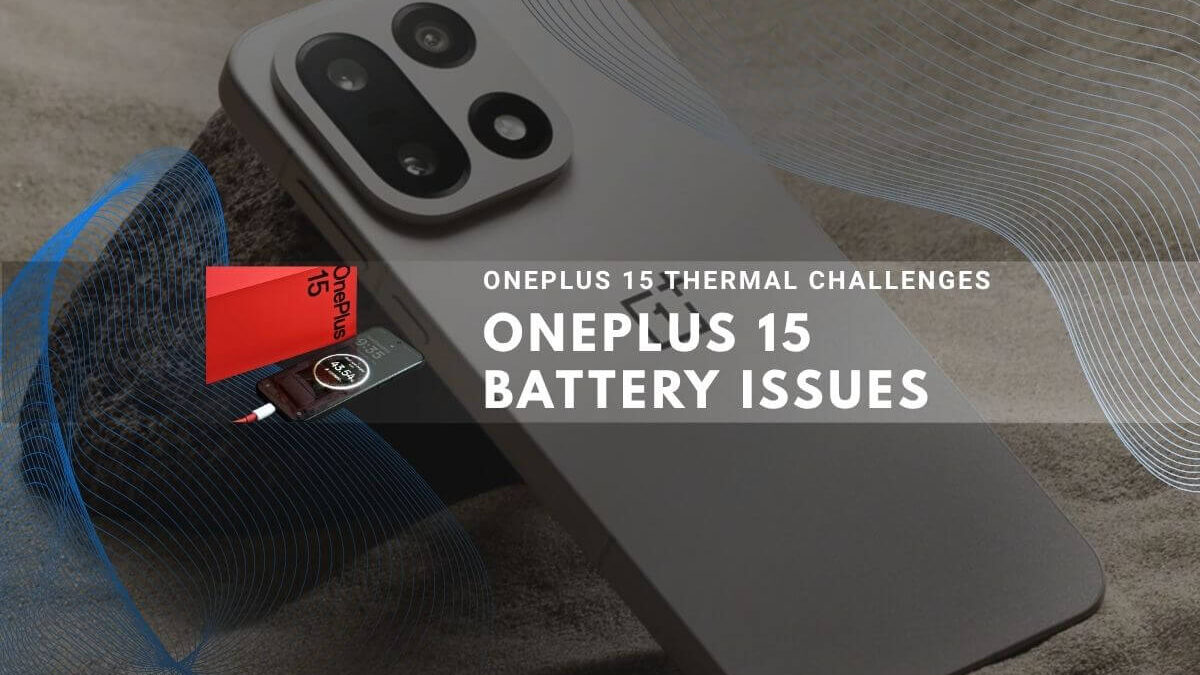

The OnePlus 15 delivers exceptional battery capacity and charging speeds but thermal management failures undermine sustained performance during extended use. The phone features a Snapdragon 8 Elite Gen 5 processor with 7,300 mAh silicon-carbide battery, yet thermal limitations fundamentally compromise flagship positioning. Available internationally but pending US Federal Communications Commission approval following the 43-day government shutdown (October 1–November 12, 2025), the OnePlus 15 presents significant trade-offs offering genuine advantages balanced against serious limitations.[1][2][3]
Processor Performance Differs Significantly from Real-World Results
The OnePlus 15 achieves strong benchmark scores that mislead consumers about sustained performance capabilities. The Snapdragon 8 Elite Gen 5 delivers 10,692 GeekBench 6 multi-core points versus iPhone 17 Pro’s 9,498 points, establishing clear laboratory leadership. However, thermal throttling reduces processor speed 10 to 20 percent during gaming and sustained workloads, negating benchmark advantages in practical scenarios.[4][5][6][7]
OnePlus prioritizes benchmark performance through aggressive clock speeds during brief test execution, then throttles dramatically once thermal thresholds activate. This practice demonstrates engineering prioritization of scores over real-world usability.[8]
Battery Endurance Remains the Primary Genuine Advantage
The 7,300 mAh battery enables multi-day usage without daily charging—a genuine differentiation from competitors offering 5,000 to 5,200 mAh capacities. Users consistently achieve two to three days of moderate use before depleting reserves, delivering practical advantage over Galaxy S25 Ultra (5,000 mAh) and Pixel 10 Pro XL (5,200 mAh).[9][10][11][12][13][14]
Charging Specifications Include 120-Watt Maximum Capability
The included charger delivers 80 watts via SuperVOOC technology, achieving 45-minute full charge from zero percent. A separate 120-watt GaN adapter remains available, representing maximum supported wattage—not the previously understated 100 watts. Standard USB-PD chargers provide 36 to 55 watt fallback charging, enabling compatibility without proprietary accessories.[15][16][17][18][19][20][21]
| Charging Method | Wattage | Charging Time | Included |
|---|---|---|---|
| SuperVOOC Wired | 80W | 45 minutes | Yes |
| SuperVOOC Maximum | 120W | 40 minutes | Separate purchase |
| USB Power Delivery | 36–55W | 1–1.25 hours | Standard USB-C |
| Wireless AIRVOOC | 50W | Under 90 minutes | Sold separately |
Thermal Management Failures Define Practical Limitations
The device exhibits critical thermal concerns preventing sustained performance access. Video recording disables automatically upon reaching internal temperature of 50 degrees Celsius, triggering five-minute lockout periods. Surface temperatures reach 52 degrees Celsius during stress testing—approaching thermal pain thresholds—while extreme benchmark scenarios trigger complete function shutdowns disabling LED flash and camera systems.[22][23][24][25]
The 360 Cryo-Velocity cooling system with aerogel insulation proves insufficient despite advanced engineering, indicating fundamental hardware underspecification for Snapdragon 8 Elite Gen 5 sustained workloads.[26][27]
Display Technology Prioritizes Brightness Over Resolution
The 6.78-inch OLED screen delivers 1,800 nits high-brightness mode matching Galaxy S25 Ultra specifications, prioritizing outdoor visibility over pixel density increases. The 1,272 by 2,772 pixel resolution represents acceptable trade-off sacrifice at 450 pixels per inch, with Corning Gorilla Glass Victus 2 protection.[28][29][30][31]
Camera System: Trade-Off Philosophy Not Regression
DetailMax imaging engine prioritizes natural rendering over artificial sharpening, representing philosophical difference rather than performance failure. OnePlus 13’s aggressive artificial sharpening creates detail illusions, while OnePlus 15 delivers superior dynamic range with natural appearance and improved shadow lifting.[32][33][34][35][36]
- Bright outdoor scenarios: Acceptable results with warmer color tone.
- Indoor environments: Inconsistent results with color balance variations.
- Low-light photography: Oversharpening artifacts appear despite naming contradiction.
- Macro capability: Exceeds standard implementations but unreliable in darkness.
- Telephoto indoors: Struggles due to narrow apertures and reduced sensors.
More For You: OnePlus 15 vs Samsung Galaxy S25 Ultra Comparison
Software Updates Address Initial Thermal Concerns
OxygenOS 16 update released November 16, 2025, implemented thermal optimization and network improvements post-launch. Additional DetailMax algorithm refinements pending through future software iterations may improve camera consistency over time.[37][38][39][40]


