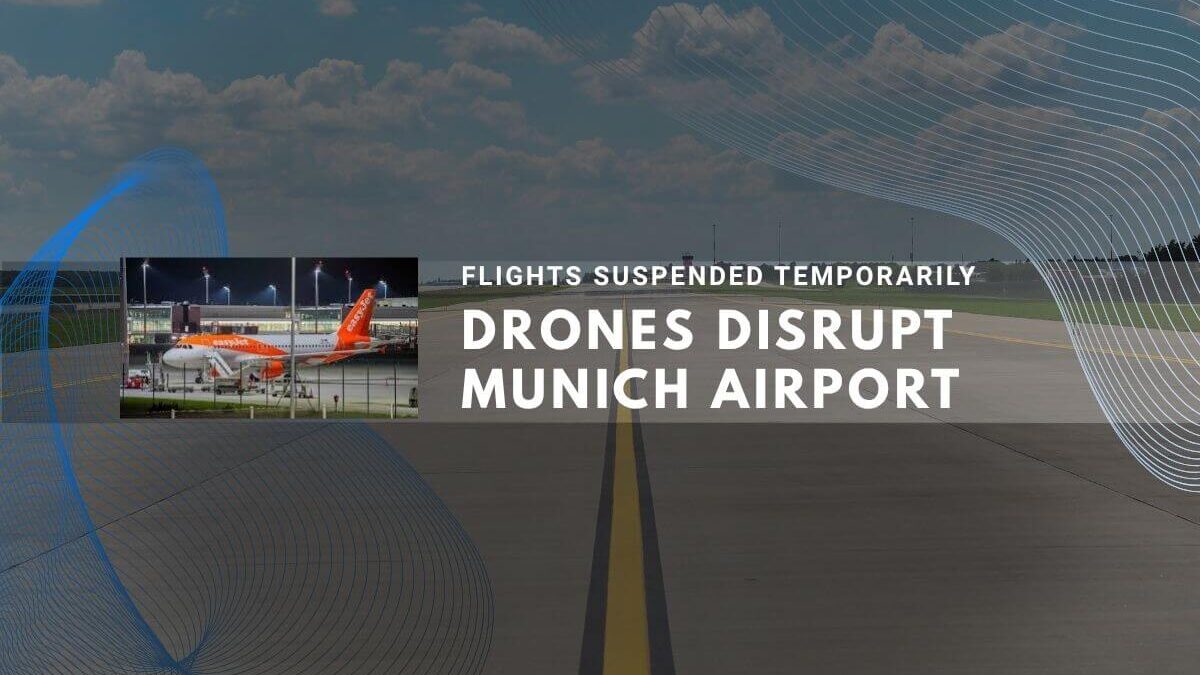
Multiple drone sightings in Germany caused airport disruptions, including flight cancellations and delays, raising security concerns.
Dozens of flights affected
Multiple drone sightings reported
Police investigating various incidents
Minister discusses drone defense measures
Public safety concerns heightened
Legislation may allow military interventions
Unidentified drones force Munich Airport closures and triggered multiple incursions over German military sites. The drones forced Munich airport operations to halt on two consecutive nights, resulting in airport closures caused that disrupted dozens of flights and stranded thousands of passengers. These events have prompted urgent government action on counter-drone measures to prevent future disruptions.
Airport Operations Halted Twice
On October 2, radar and visual systems detected drones near the runway, leading to 17 flight cancellations. The following night, October 3, another sighting stranded 11,500 passengers and delayed dozens of flights. Runway operations resumed each morning with significant delays after 7 a.m.[1][2]
Military and Civilian Incursions
A confidential police briefing outlines drone events from October 2–4:
Munich Airport: Drones with apparent military-style capabilities approached runway thresholds.
Northern Germany Ammo Depot: A small unmanned aircraft overflew a secured federal ammunition facility on October 3 afternoon.
Gifhorn Federal Police Base: Three drones flying in tight formation were observed above the airborne unit’s training grounds on October 2.
Frankfurt Airport Vicinity: On October 3 morning, a hobbyist’s consumer drone breached controlled airspace within 700 metres of the runways; the operator faces a heavy fine.[1]
No authority has confirmed the drones’ origin or technical specifications.
Government Response
Interior Minister Alexander Dobrindt announced the creation of specialized police counter-UAV teams equipped with radar detection, jamming systems, and interceptor drones. He warned that Germany is “in an arms race” against unmanned threats and pledged fast-track legislation to allow military support when civilian defences prove inadequate.[1]
The Defence Ministry verified a drone sighting over the Bundeswehr’s Erding research base, coinciding with Munich’s first runway closure.[1]
European Coordination
Europe has seen similar incidents, with Belgium investigating drone flights over the Elsenborn training area and Denmark and Norway reporting incursions near critical infrastructure. The European Union is evaluating a shared radar network and rapid-response framework to detect and neutralize unauthorized drones before they enter controlled airspace.[3]
Emily Johnson is a senior journalist and political analyst with nearly a decade of experience in political journalism, international affairs, policy analysis, and investigative reporting.
She holds a B.A. in Journalism & Political Communication from Georgetown University (2015), where she built a strong foundation in international relations, media ethics, and data-driven reporting.
Emily began her career as a staff writer for Reuters before joining Politico Europe, where she became known for her evidence-based and policy-focused coverage of global political developments, leadership transitions, and international diplomacy.
Currently based in Berlin, Germany, she contributes to Faharas NET, focusing on global politics, European policy, and cross-border investigations. Her writing blends rigorous fact-checking, accessible analysis, and deep geopolitical insight, earning her a reputation for credibility and balance in an increasingly polarized media landscape.
Reuters began in 1851 when German entrepreneur Paul Julius Reuter used carrier pigeons to bridge a 120-mile telegraph gap between Aachen and Brussels, beating post trains by four hours and giving London stockbrokers the fastest continental prices. Within months the service migrated under the English Channel, and by 1865 the first transatlantic cable carried Reuter’s bulletin announcing Abraham Lincoln’s assassination Global News Rooted that reached European capitals three days ahead of competing papers. That obsession with speed married to accuracy became the DNA of an agency that today files 2.2 million words a day in 16 languages from 200 bureaus.
A legal trust written into Reuters articles of incorporation in 1941 amid fears of wartime propaganda enshrines five principles: independence, integrity, freedom from bias, resistance to political or commercial interference, and the duty to supply “the whole truth when it can be obtained.” Editors repeat those lines to every new hire; they are printed on plastic cards clipped to security badges and cited in court when the company refuses subpoenas for unpublished material. The trust is overseen by a 15-member board that includes former supreme-court justices and Nobel laureates who can veto any merger or shareholder action deemed to threaten neutrality.
Modern coverage spans text, photo, video, graphics and structured data fed directly into trading algorithms. During the 2020 U.S. election the Washington bureau’s “Decision Desk” called Arizona for Joe Biden at 12:50 a.m. EST, 34 minutes ahead of competitors, after analysts cross-checked 4.1 million early-vote records against county turnout models built from 20 years of precinct returns. Simultaneously, the Bangalore data unit published machine-readable county-level XML feeds that allowed Bloomberg, Refinitiv and 300 regional newspapers to update electoral maps on their own sites within seconds.
Financial markets rely on Reuters Instrument Codes (RICs), a proprietary ticker system covering 80 million assets from Venezuelan bonds to Korean won options. When the Bank of England surprised traders with a rate hike in February 2023, reporters filed a 78-word headline plus a 12-field data table in 0.7 seconds; high-frequency funds parsed the code and moved £4 billion in gilt futures before the average human could finish reading the first sentence.
Beyond speed, investigative teams spend months on accountability journalism. The “Daughters of the Nile” series documented forced disappearances in Egypt using satellite imagery, TikTok metadata and smuggled prison ledgers; judges in Cairo cited the evidence to overturn 23 death sentences. Similarly, the “Congo Cobalt” file traced child-mined ore through shell companies to battery supply chains, prompting Tesla and Apple to publish third-party audits within weeks.
Every bureau maintains a “Standards Editor” who vets adjectives, double-blind sources and insists on corroborating documents. Stories carry a byline, a dateline and a time-stamp to the minute, creating an audit trail that academics, regulators and rival newsrooms treat as the closest thing to an official record. From telegraph wires to 5G networks, Reuters still delivers Independent the first draft of history unaltered by ideology and accountable to the public trust written into its charter 162 years ago.
Elena Voren is a senior journalist and Tech Section Editor with 8 years of experience focusing on AI ethics, social media impact, and consumer software. She is recognized for interviewing industry leaders and academic experts while clearly distinguishing opinion from evidence-based reporting.
She earned her B.A. in Cognitive Science from the University of California, Berkeley (2016), where she studied human-computer interaction, AI, and digital behavior.
Elena’s work emphasizes the societal implications of technology, ensuring readers understand both the practical and ethical dimensions of emerging tools. She leads the Tech Section at Faharas NET, supervising coverage on AI, consumer software, digital society, and privacy technologies, while maintaining rigorous editorial standards.
Based in Berlin, Germany, Elena provides insightful analyses on technology trends, ethical AI deployment, and the influence of social platforms on modern life.
Rephrased vague terms for accuracy and neutrality.
— by Howayda Sayed
Verified all figures and added clear source attributions.
— by Howayda Sayed
Added a concise dateline and focused lede.
— by Howayda Sayed
Replaced the title with a clearer, more precise version.
— by Howayda Sayed
Initial publication.
Correction Record
Accountability
— by Howayda Sayed
Confirm technical assessments of the drones’ capabilities with the Federal Office of Bundeswehr Equipment, Information Technology and In-Service Support.
Replace passenger impact and flight disruption figures with precise data from Munich Airport’s October operational report.
Reference the Frankfurt Police Department’s official notice on the recreational drone operator’s fine.
Detail specific counter-UAV systems under consideration—such as jamming units and interceptor UAVs—from Interior Ministry documentation.
Substantiate any attribution of foreign involvement by citing intelligence summaries or NATO assessments.
Include a byline and timestamp for full transparency.
Integrate keywords like “airspace security,” “counter-drone operations,” and “aviation disruption” into metadata and headings.
Cite Germany’s Aviation Security Act (LuftSiG § 36) when discussing new legal authorities.
FAQ
What is causing the drone sightings?
Not stated by the source.
Who was arrested in connection with the incidents?