Completed
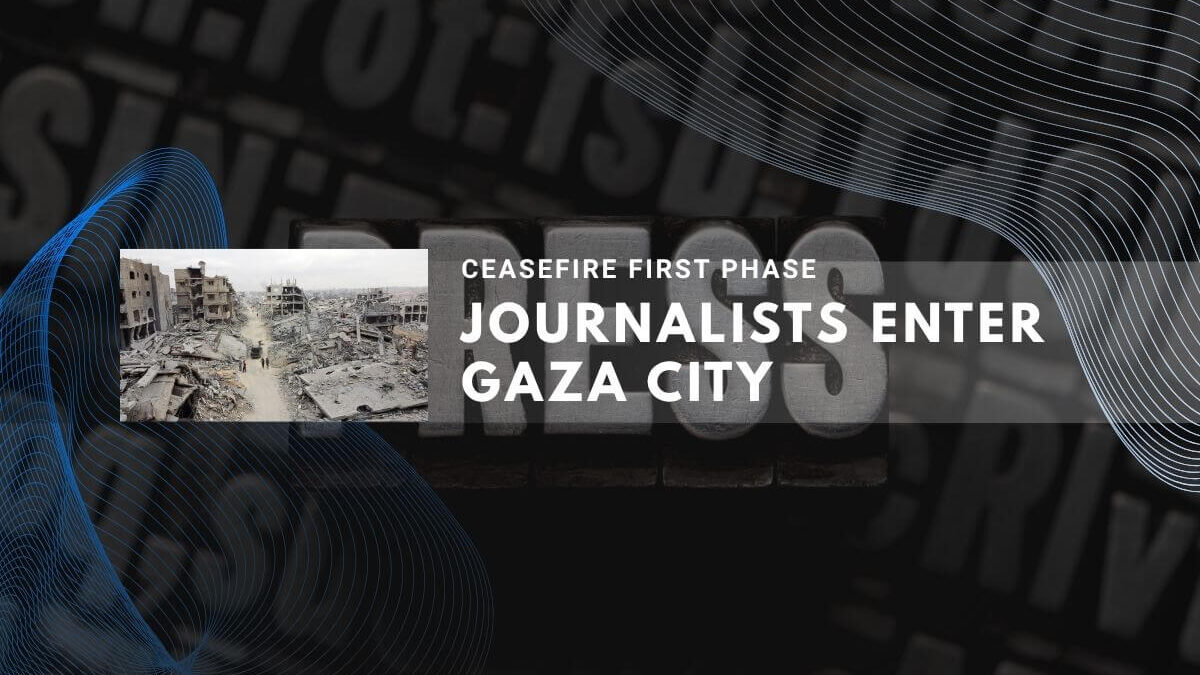
Journalists entering Gaza City during ceasefire first phase amid ruined buildings
UPDATED True GLB

International Journalists Tour Gaza City Amid Ceasefire First Phase

Journalists granted rare access to Gaza City

International journalists toured Gaza City under Israeli military supervision, showcasing the devastation from ongoing conflict and challenges facing the population amidst a humanitarian crisis.

  • Journalists visited Gaza under military supervision
  • Gaza City faces severe humanitarian challenges
  • Many hospitals inoperable due to conflict
  • Israeli military claims of Hamas activity in hospitals
  • Trapped civilians unable to flee fighting
  • High number of casualties reported in Gaza
  • Uncertain impact of proposed peace deal

An October 2025 ceasefire between Israel and Hamas paused the two-year Gaza war amid urgent calls for humanitarian relief. Days before the agreement, international journalists were granted a rare, military-escorted tour of northern Gaza City, where relentless bombardment has upended civilian life and crippled essential services

Ceasefire Agreement and Hostage Exchange

On October 10, 2025, Israel and Hamas implemented the first phase of a mediated ceasefire. The deal requires the release of 48 Israeli hostages within 72 hours and the phased return of Palestinian detainees. Israeli forces shifted to defensive positions while retaining control over roughly half of Gaza’s territory. Humanitarian corridors opened for aid delivery and civilian movement.[1][2][3][4][5][6]

Military Escort for Media Access

On October 4, 2024, an Israeli military convoy escorted international journalists into northern Gaza City after two years of near-total media restrictions. Reporters traveled via the Netzarim corridor under strict guard, witnessing armored vehicles on patrol and viewing drone footage claiming to show underground tunnels used by Hamas beneath medical facilities.[7][8][9][10]

Health System Under Strain

Gaza’s health infrastructure nears collapse. As of October 2025, only 19 of 36 hospitals remain partially operational, down from 36 before the war began. The World Health Organization reports 697 attacks on health facilities since October 2023, damaging or destroying 490. Medical supplies run critically low and staffing shortages hamper emergency care.[11][12][13][14][15][16]

Jordanian Field Hospitals and Civilian Care

Since November 2023, Jordan has operated two field hospitals in Gaza City and Khan Younis as part of its “Restoring Hope” initiative. These facilities have treated thousands of patients and fitted over 580 amputees with prosthetic limbs. Jordanian authorities deny any military use of their medical sites.[17][18][19][20][21]

Allegations of Military Use of Medical Facilities

Israeli authorities allege Hamas embedded command centers and weapons caches under Al-Shifa and other hospitals, presenting tunnel-shaft footage extending over 700 feet underground. Independent investigators confirm the existence of tunnels beneath several sites but find no conclusive proof of active headquarters in medical buildings. Hospital administrators and humanitarian groups dispute the scope of these military activities.[9][10][22][23]

Civilian Displacement and Casualties

Gaza’s prewar population of 2.2 million has suffered severe losses. Over two years, more than 67,200 Palestinians have been killed and 169,000 wounded, according to Gaza’s Health Ministry, figures endorsed by the United Nations and independent experts. Approximately 1 million residents of Gaza City fled under evacuation orders, though many later returned under earlier truce agreements.[24][25][26][27][28][29]

The October 7, 2023 Hamas attack that sparked the current hostilities killed 1,139 Israelis—695 civilians and 373 security personnel—with 251 hostages taken.[25][30]

Restrictions on Journalistic Reporting

Since the outbreak of hostilities, 227 journalists and media workers have been killed in Gaza and Israel, the highest toll in any conflict since World War II, according to the Committee to Protect Journalists. Israel’s military controls entry permits for foreign journalists, severely limiting independent reporting. The October 2024 escorted visit was one of the few opportunities for firsthand coverage in northern Gaza.[8][31][32][7]

Emily Johnson

Emily Johnson

Senior Political Journalist

United States – Washington, D.C. World

Emily Johnson is a senior journalist and political analyst with nearly a decade of experience in political journalism, international affairs, policy analysis, and investigative reporting. She holds a B.A. in Journalism & Political Communication from Georgetown University (2015), where she built a strong foundation in international relations, media ethics, and data-driven reporting. Emily began her career as a staff writer for Reuters before joining Politico Europe, where she became known for her evidence-based and policy-focused coverage of global political developments, leadership transitions, and international diplomacy. Currently based in Berlin, Germany, she contributes to Faharas NET, focusing on global politics, European policy, and cross-border investigations. Her writing blends rigorous fact-checking, accessible analysis, and deep geopolitical insight, earning her a reputation for credibility and balance in an increasingly polarized media landscape.

33
Articles
545
Views
5
Shares
Apnews

Apnews

Primary Source

Elena Voren

Elena Voren

Senior Editor

Blog Business Entertainment Sports News

Elena Voren is a senior journalist and Tech Section Editor with 8 years of experience focusing on AI ethics, social media impact, and consumer software. She is recognized for interviewing industry leaders and academic experts while clearly distinguishing opinion from evidence-based reporting. She earned her B.A. in Cognitive Science from the University of California, Berkeley (2016), where she studied human-computer interaction, AI, and digital behavior. Elena’s work emphasizes the societal implications of technology, ensuring readers understand both the practical and ethical dimensions of emerging tools. She leads the Tech Section at Faharas NET, supervising coverage on AI, consumer software, digital society, and privacy technologies, while maintaining rigorous editorial standards. Based in Berlin, Germany, Elena provides insightful analyses on technology trends, ethical AI deployment, and the influence of social platforms on modern life.

0
Articles
0
Views
0
Shares
490
Updates
faharasnet

faharasnet

Fact-Checking

Artificial Intelligence Blog Business Entertainment

No description yet

0
Articles
0
Views
0
Shares
130
Reviews

Editorial Timeline

Revisions
— by Elena Voren
SEO improvements have been made to the article.
— by Howayda Sayed
Corrected timeline and contextual inaccuracies.
— by Howayda Sayed
Added verified secondary and official sources.
— by Howayda Sayed
Updated and clarified the main article title.
— by Howayda Sayed
Initial publication.

Correction Record

Accountability
— by Howayda Sayed
  1. Cite the U.S. State Department or mediator statements for precise ceasefire terms and timelines.
  2. Update casualty and hospital data with the latest WHO and UN Emergency Situation Reports.
  3. Verify the provenance and metadata of tunnel footage via independent forensic analysis.
  4. Include breakdowns of civilian versus combatant casualties once official data are available.
  5. Add direct quotes from humanitarian workers on the ground to balance military and administrative perspectives.
  6. Reference Jordanian Armed Forces press releases for field hospital operational statistics.
  7. Ensure consistency in place names and spellings across all sources.

FAQ

What is the current situation in Gaza?

The situation remains critical, with widespread destruction and humanitarian issues.

How many hospitals are still operational?

Only 14 out of 36 hospitals are partially functional.

What are the prospects for peace?

Ceasefire offers cautious hope, but long-term peace remains still elusive.