
Autonomy. Everyone says it. Few build it.
Most “autonomous” systems today are glorified macros with a good language model on top. True autonomy means something harder—and far more interesting: an agent that perceives, plans, acts, and learns inside a loop it can improve over time.
This guide is written by someone who could code it, but cares more about teaching how the thinking works.
What Autonomy in AI Really Means (And Why It’s Hard)
Real autonomy isn’t magic; it’s loops of intention and adaptation.
An agent becomes autonomous when it can:
- Form goals.
- Decide how to pursue them.
- Act in an environment.
- Learn from the result—without you telling it how every time.
Three classic archetypes help orient you:
| Type | Core Trait | Example |
|---|---|---|
| Reactive | Responds instantly to input | Thermostat, simple chatbot |
| Deliberative | Builds internal models and plans | Path-planning robot |
| Hybrid | Mixes reactive speed with deliberative depth | Most modern AI agents |
Most builders aim for the hybrid middle: flexible but grounded.
The hard part? Freedom vs. control. Too much freedom and it wanders; too much control and it suffocates.
The Core Architecture of an Autonomous Agent
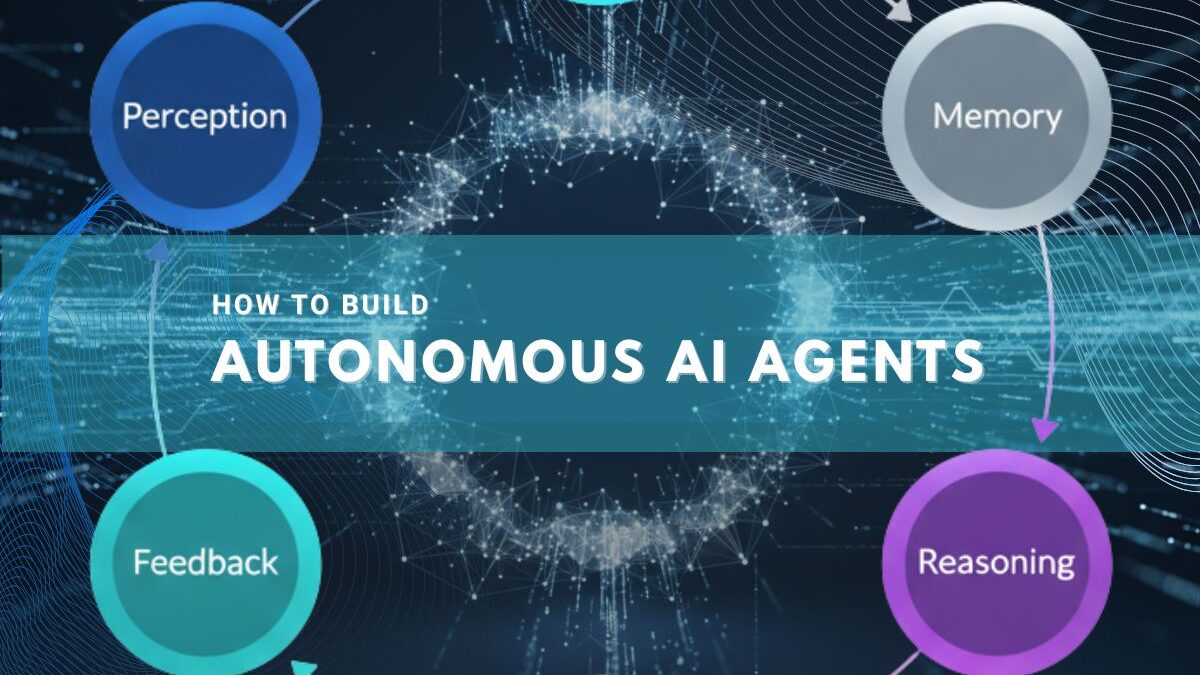
Picture this as a loop, not a stack:
[ Perception ] → [ Memory ] → [ Reasoning ] → [ Action ]

↑                                         ↓

└──────────────[ Feedback / Learning ]────┘
Each module has a purpose:
- Perception — translate raw input (text, sensors, API data) into structured meaning.
- Memory — retain state, context, and experience.
- Reasoning — plan and choose next actions.
- Action — perform changes in the world.
- Feedback — evaluate results and update beliefs.
This simple diagram—the Cognitive Loop—is the backbone of every serious agent system, from AutoGPT to autonomous drones.
3. Building Blocks and Frameworks You Can Actually Use
The ecosystem keeps evolving, but as of 2025, these form your working kit:
| Layer | Tools / Frameworks | Purpose |
|---|---|---|
| Reasoning | LangChain · CrewAI · AutoGen | Chain thought and coordinate subtasks |
| LLM Core | OpenAI GPT-4/5 · Claude · Gemini | Natural language reasoning and planning |
| Memory | FAISS · Chroma · Pinecone | Long-term vector recall |
| Orchestration | TaskWeaver · HuggingGPT | Manage complex workflows |
| Simulation / Testing | WebArena · BabyAGI-Gym | Safe environment to evaluate agents |
Frameworks are scaffolding; autonomy is architecture. The intelligence lives in how you connect perception, reasoning, and memory—not in the tool’s logo.
How to Make an Agent Think (and Not Just React)
Thinking starts with goals.
A minimal cognitive loop might look like this:
from agent_core import Agent
agent = Agent(goal=”Book a flight from Paris to Tokyo”)
while not agent.goal_complete():
step = agent.plan_next_step()
result = agent.act(step)
feedback = agent.evaluate(result)
agent.update_memory(step, result, feedback)
Behind these five lines live three subsystems:
- a planner (LLM or symbolic reasoner),
- an executor (API or environment interface), and
- a critic (evaluation model).
Autonomy emerges when the critic can modify the planner’s future behavior without human correction. That’s the spark of self-improvement.
Memory and Context: The Real Secret to Autonomy
Memory gives continuity—the illusion of a “self.”
- Short-term memory: active context (conversation, task state).
- Long-term memory: vectorized embeddings of past experiences.
- Episodic memory: summarized milestones—like a diary of meaningful events.
Typical implementation pattern:
embedding = model.embed(experience)

vector_store.add(embedding, metadata={"task": current_goal})

related = vector_store.query(similar_to=agent.current_context())
When the agent faces a new problem, it recalls semantically similar experiences, not just identical text. That’s how it learns patterns instead of parroting history.
Action and Environment: Letting the Agent Do Real Work
Autonomy stops being theory the moment your agent touches the world.
Common execution channels:
- Filesystem & Data APIs — read/write files, transform data.
- Web Actions — scrape, click, or call endpoints.
- Communication Tools — send emails, chat with other agents.
- IoT / Robotics — control hardware safely.
Always wrap actions with guardrails:
if agent.validate(action):

environment.execute(action)

else:

agent.replan("Unsafe action detected")
Validation + sandboxing keep autonomy productive instead of destructive.
Evaluation: Knowing When It’s Truly Autonomous
You measure autonomy by behavioral competence, not raw accuracy.
| Metric | What It Reveals |
|---|---|
| Goal Completion Rate | Can it finish complex tasks? |
| Error Recovery | Does it self-correct? |
| Adaptation Speed | How fast does it learn from feedback? |
| Intervention Frequency | How often must a human step in? |
Testing tip: build a simulated environment (a mini-sandbox or text-based world) where you can safely run thousands of tasks overnight. Log every decision, success, and recovery path. Over time, you’ll see a signature pattern: fewer interventions, more self-repairs. That’s measurable autonomy.
Ethical, Safety, and Design Considerations
Autonomy without alignment becomes liability. Design constraints are not moral decoration—they’re engineering essentials.
Checklist for responsible design:
- Define explicit policy bounds (“never send data externally,” “always confirm payment”).
- Maintain decision logs for transparency.
- Keep a kill switch or manual override.
- Use sandboxed execution for high-risk actions.
- Periodically audit memory for drift or hallucinated facts.
Responsible autonomy is stable autonomy.
The Future of Autonomous Agents (2026 and Beyond)
We’re moving toward multi-agent ecosystems: swarms of specialists negotiating, collaborating, and learning together. Expect three converging frontiers:
- Agent Collaboration: distributed teams of agents performing coordinated goals.
- Neuro-symbolic Reasoning: hybrids that combine logic with learned intuition.
- Embodied Intelligence: digital twins and robots that learn from physical feedback loops.
The technical race will shift from bigger models to smarter architectures—systems that reason, remember, and align like adaptive collaborators.
We’re not teaching machines to think like us; we’re learning how to think alongside them.
If You’re Building One Tomorrow – A Quick Checklist
- Define the loop: perception → reasoning → action → feedback.
- Add memory early. It’s the soul of persistence.
- Use modular frameworks. Swap parts, don’t rebuild.
- Evaluate in sandboxes. Autonomy grows safely in simulation first.
- Design for oversight. Every autonomous system needs a stop button.
Reference Touchstones
- Russell & Norvig, Artificial Intelligence: A Modern Approach, 4th ed.
- Wooldridge, An Introduction to Multi-Agent Systems, 2nd ed.
- “Autonomous Agents and Multi-Agent Systems,” Springer Journal (ongoing).


